
Demand-responsive transport is often associated with fully flexible services: passengers book a ride, and the system dynamically calculates the route based on demand.
This model can be useful, but it is not always the best fit for every region. Especially in rural areas or during off-peak hours, flexible DRT can become complex and costly to operate. Demand is often spread out, pooling is harder to achieve, and vehicle and driver resources need to be used carefully.
Line-based DRT offers another approach.
It combines the familiar structure of traditional public transport with the flexibility of on-demand operations. Vehicles operate along predefined lines, stops or corridors, but they only run when passengers have booked a ride.
For passengers, the service still feels familiar: they see known stops, lines and departure times, while operators can manage services much more flexibly in the background.
How does it work?
With line-based DRT, passengers book their trip through an app, website or booking system. The system then offers available departures based on the defined timetable.
The vehicle follows a predefined structure, but it does not always need to serve every stop. Depending on the service design, stops can be required, optional or restricted.
This allows operators to keep a clear timetable structure while adapting operations to actual demand. If there are no bookings, the vehicle does not need to run. If several passengers book within the same time window, trips can be bundled.
In low-demand areas, one vehicle can also serve several lines, helping operators make better use of limited resources.

Flexible or semi-flexible services
Line-based DRT can be configured in different ways.
In a more structured model, the service works similarly to a bus: the vehicle follows a timetable and serves the defined stops.
In a semi-flexible model, some stops are only served when there is demand. The route can adapt to bookings, while the overall line structure remains clear for passengers.
This makes line-based DRT useful for services that should remain easy to understand but need more flexibility than a conventional fixed-line bus.
Which services can be digitized?
Line-based DRT is especially relevant for existing demand-responsive services such as call buses, call taxis, Anruflinientaxis, Anrufsammeltaxis, Rufbus services or community transport.
Many of these services already support rural mobility, but they are often still organized manually through phone bookings, call centers or separate dispatching processes.
Digitizing them does not mean replacing them with a completely new transport model. It means making existing services easier to book, easier to manage and easier to evaluate. It can also simplify the coordination of services, as algorithms can support dispatching and help optimise vehicle allocation based on actual demand.
The Lines feature
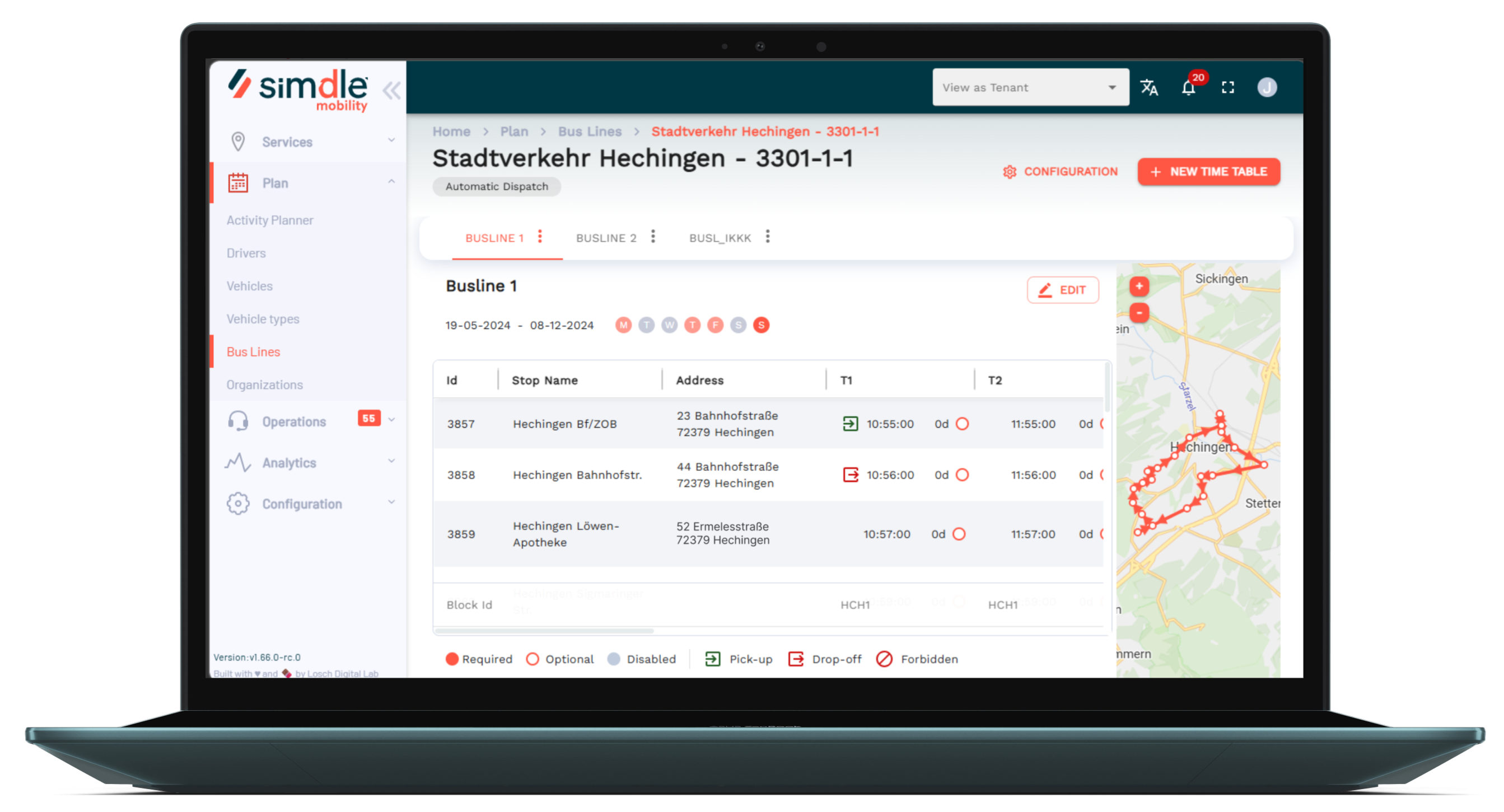
With the Lines feature, Simdle Mobility enables operators to manage line-based and semi-flexible demand-responsive services digitally.
Lines and timetables can be imported through GTFS data, or created manually. Operators can define stops, booking rules and service structures. Passengers book within the available timetable, while the system supports dispatching and route optimization in the background.
This makes it possible to operate different types of demand-responsive transport in one system, from line-based services to fully flexible DRT.
Why does it matter?
Line-based DRT can help transport operators and public authorities make existing services more efficient.
It can reduce unnecessary trips, improve vehicle utilisation and make operating costs more predictable. At the same time, passengers benefit from a familiar public transport experience with digital booking and better access to mobility.
Line-based DRT is not about replacing fixed-line transport or fully flexible DRT. Rather, it provides another option for choosing the right operating model for the region.
For many rural and low-demand areas, it can offer a practical middle ground: structured enough to be efficient, flexible enough to respond to real demand.